Tuesday, April 4, 2017

Labor Medication and Breastfeeding

Making a birth and postpartum plan can be overwhelming. So many choices, options, and consequences. You ask yourself, "will all this research and planning really have a tangible outcome?" If breastfeeding is a goal, there is a recent observational study that says "yes" it may indeed make a difference. 

Kajsa Brimdyr, PhD, CLC has recently published a study showing the association between Fentanyl epidurals and suckling challenges in infants in the first hour after birth. There are many medications that can be in an epidural, but fentanyl is one that specifically hinders the newborn infant's ability to suckle at the breast immediately after birth. Fentanyl is a highly lipid soluble opioid which easily crosses the placenta to the baby. Infants go through 9 distinct stages after birth leading up to breastfeeding which can have some really important implications if those stages are hindered.


Brimdyr observed the 9 stages of infant behavior in babies who were exposed to fentanyl via epidural. She noticed that infants exposed to fentanyl were less likely to suckle and breastfeed one hour after birth. 

So...

"We have known for some time that early initiation helps to establish exclusive breastfeeding – a life-saving practice. These new findings also confirm that getting an early start to breastfeeding boosts child survival in its own right and that the protective benefit extends well beyond the first month, until the age of 6 months."  UNICEF 2016

This study demonstrates that an epidural that contains fentanyl could very well effect long term goals of breastfeeding.

 Here is a video that summarized Brimdyr's findings:


What does this mean for you?
  • Plan what type of birth you want to have taking into consideration your breastfeeding goals.
  • Be informed about what type of medication is typically used in your hospital's epidurals.
  • Advocate for yourself and your birth medication if you plan on an epidural (or are open to one).


Monday, February 22, 2016

Organizing for Mom-Guest Post


You’ve finally taken the time to get organized, but what can you do to maintain the systems you’ve put in place? Here are some tips to make sure your efforts aren't wasted!


#1 Think before you shop. (This pertains to anything bought or acquired that makes its way into your home) Before you acquire an item, ask yourself the following questions:

-Do I need this?

-Do I really like/love this?

-Do I already have one or something that serves the same or similar purpose?

-Do I have a place to put it?

Finally, resist the urge to buy or take items you did not answer “yes” about. Try writing the items in question on a list. After a few days, see if the items are still something you want or need. Chances are the answer is no.

#2 If you find yourself answering yes to the above, try to always use the “one in, one out” rule. Swap an old item that you no longer need, love or have a place for with the new item.

#3 Set up a “donation can.” I recommend setting one up on each floor of your home. Like a trash can, these “donation cans” should be used to collect items that no longer serve a purpose for you or your family. “Donation cans” allow items to be immediately collected to ensure unwanted things don't make their way back into your home. When the can is full it’s time to take a trip to your local charitable drop off location.

#4 Schedule a weekly day to purge the house of unwanted items and to put things back in their places. You should also use this time to take inventory of items you may have run out of or need for the week(food for lunches/dinners, supplies for upcoming school projects, etc...) This cuts down on last minute shopping trips that encourage “impulse buys” as well as helps to avoid purchasing duplicates. I like doing this on Sunday night to give the week a fresh, organized start. Remember, establishing routines is key to staying organized.

#5 Remember that YOU control what comes in to your home! Practice saying “No Thank You.” When you are offered free-bees, informational brochures, unnecessary receipts or items that do not serve a purpose-JUST SAY NO☺.

Unsubscribe from magazines or coupon lists that you do not use or wish to receive.
Just because something is free or discounted does not mean that you need it. Although harmless in small quantities, continuing to aimlessly acquire these items can sabotage your efforts to get organized.

#6 Lastly, try your best to treat each one of your “to-dos” like an appointment. Scheduling tasks to be completed on a specific date and time is the best way ensure that your goals are being accomplished!


Back to Basics Organizing, LLC
Rachel Kowitz, Owner & Professional Organizer
rachel@backtobasicsorganizing.net
www.backtobasicsorganizing.net
410-404-4371

Tuesday, February 16, 2016

Upcoming IBC Events

What's even better than being a doula? Being a doula and working with a great organization called Informed Birth Choices. Check out my profile at IBC.

In addition to birth doula and postpartum doula services, IBC offers childbirth classes, comfort measure classes, infant care and breastfeeding classes. I have the privilege of teaching at IBC and I love it. 

Here are some of their upcoming classes:
  • Informed Childbirth Weekend 
    • February 20-219:30 am-3:30 pm
    • April 16-179:30 am-3:30 pm
  • Comfort Measures Workshop
    • February 214:30-7:00 pm
    • April 216:30-9:00 pm
  • Baby Basics (infant care and breastfeeding)
    • March 261:00-5:00 pm
    • May 141:00-5:00 pm
Also, IBC is offering a FREE comfort measures class with the purchase of birth doula services for all of 2016!!

Thinking about becoming a doula? Well, IBC has you covered there too. IBC is hosting both a postpartum and birth doula workshop (DONA approved) in the upcoming months. In addition, IBC offers the 3 hour DONA approved Breastfeeding for Professionals, which is a prerequisite for becoming a doula

  • Postpartum Doula Training 
    • March 18-208:00 am-6:15 pm
  • Birth Doula Training 
    • April 23-248:00 am-6:30 pm
    • August 20-218:00 am-6:30 pm
  • Breastfeeding for Professionals
    • June 41:00 pm-4:00 pm
    • September 241:00 pm-4:00 pm

Sign up for any of these classes here.

Want to meet IBC in person? Then check out the Columbia Baby Expo on March 12. 

Hope to see you at IBC!

Friday, January 1, 2016

Journey in Adoptive Breastfeeding: Part 5

This may be the hardest blog post that I write.

The journey in adoptive breastfeeding has been a long and trying one of waiting, praying and pumping. Around September, my husband and I felt that maybe we had been waiting long enough and that if we didn't get matched by December that we would come off the adoption list. We planned a trip to Hawaii with my sister and her husband (and no kids) and kind of prepared ourselves for the end of our journey. Well, sure enough, we got a call  that we were matched with a baby girl who was due on late October. "Over the moon" doesn't begin to describe how we felt! We were so thrilled that our dream of a third child, a daughter, was about to come true. We were so over Hawaii and ready to be parents again. She was perfect and right on time (on her due date).

Now there was the "small" decision to make: do we take direct placement of her knowing that the birth parents have 30 days to change their minds or should we just wait out the 30 days with her in transition care through our adoption agency. It seemed simple to us. We want to care for her and love her as soon as possible. So with some negotiating, we were able to take placement of her 8 days after her birth. We named her Mychelle Sydney Byrd. And she was with us for two weeks...

She was such a lovely, sweet baby, who had no problem going back and forth from nursing and bottle feeding. Breastfeeding was such a sweet time for me and she loved it too. I am so blessed that I got to experience that. I know for many women it is hard and doesn't go as planned, but for Mychelle and I, it was magical!

After two blissful weeks, our adoption agency called us and told us that her birth parents decided to parent her. We were completely devastated. We cried with each other and with our friends and family who showed us great love and compassion during the process of returning Mychelle to her birth family. It was the hardest and saddest thing that we ever had, and I hope ever will have, to do. I hold on tightly to the memories I have of her and miss her.


Ok, so what about the pumping? I stopped pumping gradually. Since we weren't sure if we were going to continue on the adoption list or not, we decided to stop pumping. It was important not to stop all at once so that I didn't get blocked ducts or mastitis. It took about two full weeks for my body to stop lactating. During this process, I had to not only mourn the loss of a baby, but also my breastfeeding experience.  I was able to find some families who could use my frozen breastmilk, which is some consolation.

We did end up going to Hawaii to get away for a while, but Hawaii ended and we were thrust back into the reality of our loss. We are at a great crossroads. Should we keep waiting for another baby or move on to see what life brings us? More to come...I hope.


Tuesday, August 11, 2015

Mom on a Mission

I was recently interviewed by a friend for her blog. She is doing a spotlight on "women on mission".

"Doula Annie Byrd is passionate about missions. She also loves crafting. A mother of two young children, she donates her precious free time to sew treasures for Mama and Baby that she sells to raise money for the Fistula Foundation.


Photo Courtesy of Baby Byrd Doula

"Fistula is a life-altering injury caused by childbirth. Women in third-world countries who lack proper obstetrical care can be particularly vulnerable. Maybe fistula awareness is a cause near-and-dear to your own heart. Or maybe, like me, you’re just learning about it. Annie suggests checking out the Fistula Foundation website for more information. You can also check out posts on her own blog, Baby Byrd Doula.


Annie first became aware of the fistula problem when she read a book called Half the Sky: Turning Oppression into Opportunity for Women Worldwide..."


Click here to read the rest of the interview.


Monday, August 10, 2015

Journey in Adoptive Breastfeeding: Part 4

13 months...that's how long I have been pumping. The year really flew by. There were many times I just felt like giving up, mostly on trips when finding time to pump was harder and storing pumped milk was nearly impossible. But I haven't given up yet, in fact it has been so incorporated into my lifestyle that it feels almost like brushing my teeth or eating breakfast. It is just something that I do everyday...6 times a day.

Here is an update on our adoption process...
(Click here to catch up if you don't know what is going on: Part 3)

The summer has been really hard. I felt like I was holding my breath, waiting for Miles' birthmother to call and let us know what was going on. The last time the social worker spoke with her was early April. She hadn't been to the doctor but thought she was 6ish months pregnant. She scheduled her first prenatal appointment shortly after the social worker's visit. Then, well, she fell off the face of the earth. Radio silence. The adoption agency tried to contact her several times with no returned call. Lance and I decided to just wait through July and maybe she would contact us after the baby was born. July has come and gone with no word from her. So, we have moved on (as much as you can) and we are back on the waiting list.

It has been so emotional to go through two missed adoptions. Much harder than I could have imagined. But the pumping must go on...

There have been blessing as I have waited.

I've had to rely on others more emotionally theses past months, which is harder for me. I am usually the one who people can rely on.

I've had to take a break from doula-ing because of the uncertainty of the adoption. This allowed me to enjoy my summer fully with my kids and husband without being distracted.

I was able to donate milk to several mothers who either adopted a baby or didn't produce enough milk on their own. That was really rewarding to know that my milk is helping another baby and momma.

I have been able to normalize pumping/breastfeeding for my children. My hope and prayer for my boys is that for the rest of their lives they view breasts differently than the typical American culture.


So the journey continues...still...


Thursday, May 21, 2015

A Doula: Picture It!

Recently I attended a birth of a client who had a birth photographer.  Many people may ask, "why have a photographer take pictures of you in pain or when you are most vulnerable?" My answer is that the most vulnerable pictures are sometimes the most powerful, capturing the struggle and essence of life. Birth is painful and messy, but it also moving and beautiful.

As a doula, it is my role to be that the person working in the background, so it is not often that my role is captured. A lot of times, I am taking the pictures for the family so that they can focus on their birth and baby. Maybe you've never seen a doula in "action". As a doula I...


Come to your home when your labor starts...even at 3:00 in the morning...


Offer comfort measures like message...


And the TENS unit...


Help you to know when it's time to head to the hospital or birthing center...


Work closely with medical staff, in a non-medical way, to help you have the birth you want...


Bring you anything you need...


Talk and laugh with you in between contractions...


Reach out when you need a hand...


Support your partner and help him support you...


Support your breastfeeding efforts...


And celebrate new life with you!

I am your constant physical, emotional and information support through YOUR birth and it is such a joy! Thank you!

Special thanks to Marcella, Alex and Jade Vinson for allowing me to blog their photos. Also, all photo credit to goes to Lindsay (http://www.labirdiephotography.com/about-contact/). Thanks!

Thursday, April 30, 2015

Journey in Adoptive Breastfeeding: Part 3


It has been almost 10 months of pumping about 10 ounces of milk a day. I was surprised with how fast that can fill up two deep freezers. So in January I started looking for people to donate my milk to.


A friend of a friend recommended a lady to me whose daughter has Spinal Muscular Atrophy. According to this family, SMA is the #1 genetic killer of infants, and 50% of babies do not live past two years of age. The little girl, who is about 9 years old now, (let's call her "E") has weak muscles,which affect her ability to sit up, speak, eat by mouth and breathe completely on her own. Because she cannot swallow, E is fed through a g-tube. Due to SMA, she is prone to respiratory infections that are life threatening. When the family started adding breast milk to her diet at the beginning of 2009, and they saw improvements in her health right away! I'm not surprised--breastmilk is awesome! So I was able to contact this family to donate my milk. I had blood tests done to ensure that I wouldn't pass any diseases to her and had to fill out extensive forms. My hope is that my extra breastmilk will help E live a little longer and a little better.


So where are we in the adoptive process?


We were selected by a birth mom who is pregnant with a girl and due in May. Since then, our son Miles' birth mom has contacted the adoption agency, that she is also pregnant. She does not yet know how pregnant she is or the gender of her baby. But, she has asked if we will adopt Miles' birth sibling.


The adoption agency has given us the choice, adopt the baby girl we were originally selected for, or adopt Miles' birth sibling. Adopting both is not allowed by state law. For us, the emotions are hard, but the decision was simple. We have always said we would adopt a birth sibling of our adopted children, if we can. We know its best for Miles, our family, and Miles' birth family, for us to adopt his birth sibling.


So now we just sit back, store breastmilk and wait. More to come...

Wednesday, January 21, 2015

Vitamin D


This cold and flu season, vitamin D has become my new obsession. It all started last summer at the Catonsville Birth, Baby and Family expo (check out my blog post). I was minding my own business at my little booth, when I was accosted by an unkempt fellow. He started right in. "What is the leading cause of illness in the United States? Lack of vitamin D" You name it; infertility, autism, cancer, heart disease, allergies, auto-immune disease; was all to blame because of lack of vitamin D. Somehow he hooked me. I had no idea who he was or what his deal was, but something about what he was saying pulled me in. So I, uninformed, got onto the vitamin D train. My hubby was all about it too. I guess I was just as convincing as, what we now affectionately call that random guy, "Vitamin D Man". We ordered supplements, skipped the flu shot and were full into the vitamin D "thing".


Just recently, I decided to look into vitamin D some more. Here is some of what I found.

What is vitamin D?

Vitamin D isn't really a vitamin at all. It is a hormone that plays a central role in healthy bones, muscles, immune system, cardiac system and neurological function. Vitamin D is produced in your skin, triggered by the UVB portion of sunlight and activated by your liver and kidneys. There are vitamin D receptors on almost all of the cells in the human body from the bones to the brain. Many scientist believe that vitamin D controls cell growth. If that is true then you can see why vitamin D plays a huge role in the health and function of the body as a whole.

What is the source of vitamin D?


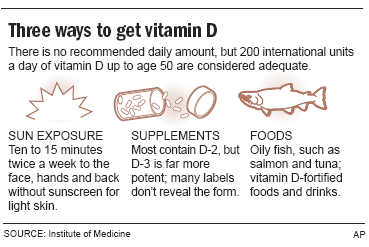
  1. The biggest source to help your body make vitamin D is the sun. Sun triggers the production of vitamin D in your skin, however, if you apply sunscreen, the UVB (and UVA for that matter) is blocked out and therefore your skin will not make as much vitamin D. Even with a sunscreen as low as SPF 8, the UVB portion of light will be 90% blocked from your body, therefore significantly decreasing the amount of vitamin D your body can make. The amount of sun you need to make enough vitamin D during the summer months depends on your skin tone, latitude where you live, and the month. Vitamin D calculator
  2. You can also get vitamin D through your diet. Oily fish and milk or juice fortified with vitamin D are the main dietary sources of vitamin D.
  3. Supplementing is another way to get vitamin D. When looking for vitamin D supplement, choose one with D-2 or D-3. 
It is also important to make sure you get enough calcium in your diet since vitamin D and calcium work together to make your body healthy. I will leave calcium for another blog post.


Vitamin D made in the skin (triggered by the sun) lasts twice as long in the body as if it were acquired through diet or supplements.

What role does vitamin D play in health?

  • Bone Health: prevents osteoporosis, rickets and fractures
  • Cellular Health: prevents some cancers, some infectious disease, and asthma
  • Organ Health: prevents heart disease, stroke, type 2 diabetes, and tooth loss
  • Muscular Health: supports healthy muscles
  • Autoimmune Health: prevents MS, type 1 diabetes, and Crohn's disease
  • Brain Health: prevents depression, schizophrenia, and dementia 
  • Mood-related Health: prevents seasonal affect disorder, PMS and sleeping disorders

This diagram pretty much sums it up:


Why is vitamin D vital during pregnancy and lactation?

Since growing babies in utero receive their vitamin D from the mother, it is crucial that the mother has enough vitamin D for her and the baby during pregnancy. The same goes for breastfeeding mothers. The mothers themselves make the vitamin D for their babies until they are old enough to make their own. Mothers who are vitamin D deficient will have babies who are vitamin D deficient. To read more about vitamin D and breastfeeding click here.


What are the main take aways about vitamin D?

  • The best source of vitamin D is through sun exposure. About 10-15 minutes of noon-time sun (again depending on latitude and skin type) exposure during the summer months (without sunscreen) is enough for your body to store enough vitamin D for the winter.
  • Vitamin D and calcium are best friends!
  • Vitamin D affects your whole body, not just your bones.
  • It is vitally important for pregnant or lactating mothers to have sufficient vitamin D levels so they can pass that to their babies.
Come on summer!! 


Most of the information in this blog post came from The Vitamin D Solution by Michael F. Holick, Ph.D., M.D.


Monday, October 20, 2014

Bacteria, Babies and Breastfeeding

Did you know that 1 out of every 10 cells in your body is human? That means that 9 or 10 are some other type of cell, most of which are bacteria. In fact, in the human gut alone, there is 3 pounds of bacteria. The human skin is also covered in bacteria, good and bad. As humans, we need these "good" bacteria to live and they need us. Babies are born with no bacteria on their skin or in the intestinal tract. They are essentially sterile. So how can you help make sure your baby is colonized with good bacteria (like lactobacillus, bifidobacterium, acidophilus, etc) instead of bad (staphylococcus, streptococcus,)?


There are some simple ways that you can expose your baby to good bacteria.

Your Birth Plan:
Plan on having a vaginal birth. When your baby is born vaginally, he/she comes into contact with good bacteria in your vagina (lactobacilli). This is the first bacteria that colonizes your baby's gut microbiome. Also, as your baby passes through your vagina and past your rectum during a vaginal birth, your baby will come in contact with helpful bacteria near the rectum.  If you have a c-section and the baby does not pass through the vaginal canal, the first bacteria your baby could be colonized by is negative bacteria (staphylococcus) in the operating room.


Skin to Skin:
If your baby is placed skin to skin on your chest immediately after birth, then your baby comes in contact with the good bacteria from your skin. If mom and baby have to be separated, then it is beneficial for dad to do skin to skin until mother and baby can be reunited. Interestingly, the vernix (white coating on baby after born) is very sticky and is food for good bacteria, so leaving this coating on is actually protecting your baby against bad bacteria (i.e. delaying the first bath may be a good idea).


Breastfeeding:
Exclusive breastfeeeding is the most important thing that you can do to ensure that your baby's intestinal tract is colonized by helpful bacteria. Breastfeeding not only contains probiotics, or good bacteria, but also contains prebiotics, which is the food that probiotics eat. The good bacteria can essentially eat up all the food leaving no room for the bad bacteria.


So why is it so important to expose a baby to probiotics?  Probiotics, or good bacteria, improve baby's immunity, reduce diarrhea, help digestion, and reduce the risk of other illnesses. Your baby will be get bacteria in their gut, skin and mucosal membranes. What type they get, is up to you.


Tuesday, September 30, 2014

Journey in Adoptive Breastfeeding: Part 2

So surprise, yes, I plan to and hope to breastfeed our third child one day. The funny thing with adoption is that you could get a child right away or wait a very long time (years even). So with that in mind, I began the induced lactation protocol. I started the birth control right when we got on the waiting list and continued it for about 5 month (about 20 weeks) not taking the reminder pills. I didn't have my period for that whole time. Then I stopped the pill and began to pump. To my shear delight, I was pumping what looks just like colostrum! I couldn't believe it! It took many days (up to about 7-8 days) for my colostrum to change to mature milk, but eventually it did. I usually pump about every two hours during the day. I decided not to make myself crazy, so I have not been pumping at night. I believe that this is one reason the I don't have a full milk supply. I am able to pump about 10 ounces per day.

My husband bought be a great big deep freezer to store the breastmilk in for 6-12 months. The idea is that I will probably not ever have a full milk supply, so I will have extra to supplement with. I have probably about 500 ounces of milk stored. Exciting!


My hope is that I will be able to successfully breastfeed, even partially. But only time and a new baby will tell. More to come...

Thursday, September 11, 2014

Journey in Adoptive Breastfeeding: Part I

Sometimes in my field of work it is hard for me to talk about my personal struggles with miscarriage and infertility. I am able to be a part of so many women's birth stories and am truly honored to do so. But every once in a while I feel like my body has let me down--that what I was meant to do as a woman I can't. So although, I am unable to carry a child, my body is still capable of breastfeeding. So breastfeeding has become very important to me.

Both of my sons are adopted, so I thought breastfeeding was out of the question for me. As I began down the path of adoption, I realized that this was still an option. I read books like, Breastfeeding the Adopted Baby and Relactation and Breastfeeding the Adopted Baby and studied Jack Newman's Protocol for Induced Lactation for hours before my first son was born. I was truly determined. I started the protocol a couple of months before my son was born (although we didn't know that we would be chosen so quickly). My goal was to build up a supply of breastmilk in the freezer and breastfeed as much as I could, depending on my supply. Mason was born and we were selected much faster than I had anticipated, so I wasn't able to complete the protocol, and it showed in my milk supply (or lack there of), but I still tried. Although, I had no mass of breastmilk stored in the freezer, I began to pump. I also bought a special supplemental nursing system called a "Lact Aid" to supplement my milk supply--boy was this thing frustrating to use!


Despite my (I wouldn't say "best") efforts, I was unsuccessful at breastfeeding, but I did pump and bottle feed for four months. My particular breastfeeding experience with Mason was very disheartening and I thought once again that my body had let me down. Time passed and then we adopted our second son, Miles, who I immediately decided I wasn't going to even try to breastfeed him, so that I could avoid the feeling of failing. I guess I thought, "if I don't try, I can't fail." To this day, I wish I had given it a fighting chance with Miles.

So here we are on the waiting list for our third child--a girl! Will I breastfeed or won't I?...more about my addoptive breastfeeding journey to come in Part 2.

My two crazy boys!

Tuesday, September 9, 2014

Full Circle

My doula career started with a friend. For many years I struggled through miscarriages and infertility, and although very challenging for my spirit, I learned A LOT in the process about pregnancy and birth. Although I had never physically had a child, many of my friends turned to me when they had questions about labor. One particular friend is the one who sparked my doula career and encouraged me to follow my dreams. She went out on a limb and asked me to be her doula. I was very nervous, but I got trained and attended her marathon birth in July of 2012. She had a beautiful little boy, who now, calls me Aunt Annie (and sometimes even momma by mistake). I love that little guy!


So, when she got pregnant again, I was thrilled that she asked me to attend her birth again. This time it was much quicker and she gave birth to a gorgeous baby girl.


My friend was my first repeat client. I felt like my journey was coming full circle. If it wasn't for her asking me to be her doula, I probably never would have been. I am so grateful! On a funny note, at her first birth one of my other clients went into labor at the same time. I, unfortunately, couldn't attend since my friend's birth lasted SO long. During her second labor, another client was being induced the same day. This time I was able to attend both births in one day. Pretty awesome!


Monday, July 28, 2014

Peanut Ball

Many pregnant women are familiar with the classic "birth" ball (basically just a fitness ball) prenatally or during labor. It is great for opening the pelvic floor and getting the baby in a good position. Many women also think it is more comfortable during contractions and labor on it the whole time.


A new type of "ball" that is used in labor is the peanut ball. It is great for using in the bed to open the pelvis and make labor more comfortable. Since it is used in the bed, this ball is great for moms who choose an epidural, but still want to take advantage of effective position changes.


Ask your care provider if they have the peanut ball the birthing environment where they practice. For more information about the peanut ball, check out this video:


Sunday, July 27, 2014

Catonsville Birth, Baby and Family Expo

I recently represented Informed Birth Choices at the Birth, Baby and Family Expo in Catonsville located at Bay State Chiropractic. It was a beautiful day with tons of vendors ranging from Prenatal massage to the YMCA of Catonsville. After being there, I was delighted to realize that there is a great birth and baby community right here in the heart of Catosnville. There are many child birth classes, prenatal yoga, acupuncture, chiropractors, and doulas in our local area. Although this was the first expo of this kind in Catonsville and therefore not highly attended, my hope is that next year people will realize the resources that they have right in their backyard.

Here are some of the vendors in attendance:

Bay State Chiropractic
Happy Family Organic
Luz de la Luna
Informed Birth Choices


Short Documentary on Rising C-section Rates in the US

I recently stumbled on this short documentary done by the New Yorker on the rising C-section rate in the US. Following one woman's story, it identifies some causes of the soaring rate of C-sections, offers hope in VBAC, and shows the rewards of natural childbirth. This piece also promotes the use of a doula during labor and childbirth.

Monday, June 16, 2014

TENS in Labor

There are many techniques a doula can use to help you with the pain and discomfort of labor; like massage, counter pressure, heat and cold therapy, position changes, etc. However, recently I was introduced and trained in yet another great comfort measure for labor. The TENS (Transcutaneous Electrical Nerve Stimulation) has been used for years to help control pain and labor is a great place to see it in action.

So what exactly is a TENS?
  • It is a handheld, battery-operated device, which transmits mild electrical impulses through the skin to stimulate nerve fibers in the back that is controlled by the laboring client. 
  •  It reduces pain in labor while allowing the laboring woman freedom to move and walk.
  •  It is especially useful for back labor.
                  

Is there research about the TENS in labor?
  • Research findings on TENS (Carroll et al, 1997) have shown that laboring women using the device use less pain medication than women using a “sham” TENS device. 
  • The majority of women surveyed (Chamberlain et al, 1993) rated it as moderately or very helpful in relieving pain, and would use it again in a future labor. 
  • A study that investigated the use of TENS for back pain in labor found that “TENS has a specific beneficial effect on pain localized in the back.” 
Why does is work?
  • Gate Control Theory of Pain: basically non-painful or pleasurable sensations travel to the brain faster than painful sensations, therefore reducing the amount of pain sensations felt.
  • The TENS actually stimulates your body to make its own natural pain relieving hormones called endorphins.
  • The laboring mother controls the TENS so she is able to take control, in a sense, of what is happening with her body.
Who should use it?
  • Any laboring mother who has received consent from their care provider who doesn't suffer from epilepsy or have a cardiac pacemaker.
The TENS is a safe and effective way to reduce the sensation of pain during labor. If you are interested in using a TENS during your labor, contact your doula or feel free to email me and I can give you more information.


*Information modified from Penny Bussell

Thursday, May 22, 2014

IBC and the Fistula Foundation

For months Informed Birth Choices has been planning a great event to encourage car seat safety and raise money for the Fistula Foundation. Finally the day had arrived. The weather was perfect for IBC's New Moms Group to host this awesome outdoor event.


Chloe Chrysanthus, an IBC doula and car seat specialist, volunteered her time to check and properly install infant and toddler car seats for free. Since 8 out of 10 car seats are installed improperly, this was a great service to all the moms who came out.


In addition to the care seat check and installation, IBC also asked for donations for the Fistula Foundation, an organization which performs surgeries to correct obstetric fistulas for women in developing nations. People graciously donated baked goods and handmade crafts to sell to raise money.


Danielle Koontz, the director of IBC, was hoping to raise around $50 and to her great surprise the money collected totaled $250! That amount is over half the cost of a fistula repair. The IBC car seat check and Fistula Foundation event was a true success and showed that women all over the world can change each others' lives for the better. Truly this event was a win-win for everyone involved! A BIG thank you to everyone involved!


Tuesday, May 20, 2014

Breastfeeding and Working


One of the most frequently asked questions that is asked when I am teaching a breastfeeding class is, "when should I introduce the bottle since I have to go back to work?" or "when do I start pumping when I have to go back to work?". Breastfeeding, pumping and working seems like it will be completely overwhelming to new moms, but it doesn't have to be. Learning how and when to pump can happen gradually and doesn't have to cause you anxiety.

Here are some of my tips for moms who will have to go back to work:

1. Establish the breastfeeding relationship with your baby first. It is more important to learn how to breastfeed and then worry about pumping.

2. Introduce the bottle after three good weeks of breastfeeding (if the first week sucks, then three weeks after you and baby got the hang of it).

3. When you do start pumping, try pumping in the morning when your milk supply is at its peak. Breastfeed the baby first and then pump the remaining milk. Add in pumping sessions throughout the day and eventually you will start making enough milk to store in the fridge and freezer.

4. Feed your baby from the bottle at least once a day so he/she gets used to bottle feeding.

5. Let the baby lead the feeding by holding baby more upright with the bottle at a 45 degree angle. Encourage her natural breastfeeding instincts (rooting, flanged lips, switching arms, etc.)

6. If your baby won't take the bottle from you (mom), allow someone else to offer him the bottle.

7. Pump when you can at work. It doesn't have to be when your baby would eat. Take advantage of your "pumportunities"!


How and when do all these things occur? Here is an action plan from the IBC Baby Basics class that I teach.


Are you interested in more information about breastfeeding and working? 


Webinar on breastfeeding and working:


Wednesday, May 7, 2014

From One to Two: Preparing Older Children and You for a 2nd Child

The sibling relationship is likely to be the longest lasting relationship that your child will have, but making that transition from one child to two, isn't always easy. Not only can it be challenging for the older child, but having another baby can also put stress on the parental relationship. Preparing yourselves and your child for the next baby can be very helpful in easing the transition.


Normal things to expect are parental conflicts, increase in stress and workload, ambivalence and/or hostility from the first child. Not all effects of a second child are negative, but the negative aspects are usually the hardest to deal with, so below are some strategies in preparing you and your child for what may come.

Preparing the Parents:
The birth of a second child can sometimes begin the most difficult year in a couple's relationship, therefore working on the parental relationship can have a positive results on parenting. Communication is the key to avoiding conflict.

Here are some questions to ask each other before your second baby is born:

  • What is your vision of the division of labor?
  • How should we handle it if our expectations aren't met?
  • What has worked well for us, as parents, so far?
  • What has been stressful about our teamwork?
  • How can we prepare for a new baby?
  • What causes you stress with our first child?
Every change requires a loss. Think about what you might lose and talk to your partner about your concerns (time together, sex, sleep, personal time, etc.)

Preparing the Child:
Although there are many things that you can do to prepare the older child for a sibling, the child's personality has the greatest effect on the reaction to the new baby. Also, his/her developmental stage can really effect how he/she reacts to the baby sister/brother.

Here are some things to try that may ease the transistion:
  • Read sibling books together
  • Play baby doll games
  • Teach older child the do's and don'ts with the new baby
  • Maintain scheduling consistency as much as possible
  • Encourage questions
  • Describe where they will go and who will watch them during the birth
  • Encourage involvement in preparations
  • Embrace resistance and regression
  • Carve out along time
  • Don't make promises that you can't keep.
When children are making the transition into the role of big brother/sister, they need to know that their emotional needs are taken care of. They need to feel included, respected, important, accepted, and secure.  Also, avoid overt favortism, treat each fairly, honor the children's difference, avoid comparrisons and labeling them, and don't assume that all conflict is bad.

Having a second child can be very stressful on the family during which a lot of adjustments occur, but it also a very joyous time. So, prepare yourselves and your child for the wonderful addition to your family.

For more on sibling adjustment you can listen to the is free webinar.

Books:  Beyond One, Jennifer Bingham and How to Raise Emotionally Healthy Children, Gerald Newmark